


Greenhouse gases: What are scope 3 emissions?
To develop and implement a decarbonization strategy and corresponding reduction targets, all greenhouse gas emissions, or GHG emissions, along the entire value chain must be fully recorded and accounted for — including those that arise outside a company’s immediate business activities.
In addition to direct emissions (Scope 1) and indirect emissions from purchased energy (Scope 2), the so-called Scope 3 emissions are particularly important. These comprise all other indirect emissions caused by the activities of third parties. They therefore originate from sources that are neither owned by the company nor directly controlled by it.
The basis for recording and calculating these emissions is the internationally recognized Greenhouse Gas Protocol, or GHG Protocol. It defines standards for quantifying and managing greenhouse gas emissions and serves as a reference framework for numerous companies, non-governmental organizations (NGOs), and governments worldwide.
Overview of the 15 Scope 3 categories
Scope 3 emissions generally account for the largest share of a company’s total greenhouse gas emissions. They relate to all activities that are indirectly connected to business operations. The GHG Protocol divides these emissions into 15 specific categories that cover both upstream and downstream activities along the value chain.
The 15 categories of Scope 3 emissions
1.Purchased goods and services
Emissions from the production of materials, intermediate products and services purchased by a company, such as metals, electronic components or external cleaning services
2. Capital goods
Emissions from long-lived assets that arise before they are put into operation, for example during the manufacture and transport of machinery, vehicles and infrastructure elements
3. Fuel- and energy-related activities
Emissions that arise in the upstream chain of energy products, such as during the extraction, transport or processing of electricity, as well as, where applicable, emissions from the sale of electricity to external third parties
4. Upstream transportation and distribution
Emissions from the transport of purchased goods carried out by external service providers, for example by truck, ship or aircraft
5. Waste generated in operations
Emissions from the disposal, incineration or recycling of operational waste, such as packaging, metal residues and office waste
6. Business travel
Emissions caused by employees’ business travel, for example through air travel, rental cars or hotel stays
7. Employee commuting
Emissions caused by employees’ travel to and from work, regardless of the mode of transport used
8. Upstream leased assets
Emissions from facilities, vehicles or buildings that are operated by companies but not owned by them, unless already included in Scope 1 or Scope 2
9. Downstream transportation and distribution
Emissions from the transport of sold products to customers or retailers, for example through freight forwarders, courier services or wholesale logistics
10. Processing of sold products
Emissions that arise when sold products are further processed or refined by other companies
11. Use of sold products
Emissions from the use of products by customers, for example from the consumption of sold fuels
12. End-of-life treatment of sold products
Emissions that arise during the disposal, landfilling or recycling of products at the end of their life
13. Downstream leased assets
Emissions from the leasing of company-owned goods, such as machinery and vehicles
14. Franchises
Emissions from franchise operations that operate under the company’s brand but are legally independent, such as station retail outlets or licensed catering businesses
15. Investments
Emissions associated with financial holdings or portfolios, for example funds, equity interests in companies or projects with high emissions
In accordance with the requirements of the GHG Protocol, companies should first prioritize the material Scope 3 categories to be included in reporting. A quantitative estimate of emissions helps identify the most significant activities, for example by using industry average data or estimates.
Alternatively, companies can also use the financial significance of the activities or the associated risks and opportunities for the value chain as criteria for prioritization. The prioritized categories defined in this way form the basis for reporting and enable targeted data collection as well as effective measures to reduce emissions.
Deutsche Bahn’s climate protection target is based on the Net-Zero Standard of the Science Based Targets initiative (SBTi) and is backed by an implementation plan. The SBTi is a renowned non-governmental organization (NGO) that has developed a science-based methodology for setting climate protection targets.
DB has committed to reducing its greenhouse gas emissions across the entire value chain to net zero by 2040. The plan is to reduce Scope 1 to Scope 3 emissions by at least 90 percent compared with 2019. The remaining residual emissions of no more than ten percent, which are difficult or impossible to avoid, will be neutralized from 2040 onward — meaning they will be removed from the atmosphere and permanently stored through technical or nature-based solutions. This science-based target was validated by the SBTi in March 2025.
Scope 1 and 2: absolute reduction pathways adopted
For Scope 1 and 2, DB has adopted absolute GHG reduction pathways based on high data quality. These include both the net-zero target by 2040 and an absolute interim target by 2034, as required by the SBTi.
Greenhouse gases: What are Scope 1, 2 and 3 emissions?
Significant scope 3 emissions at Deutsche Bahn
Around 70 percent of Deutsche Bahn’s GHG emissions currently fall under Scope 3. Accounting for and managing these emissions is challenging because they include, among other things, GHG emissions from the upstream and downstream value chain involving suppliers, service providers and customers. These emissions arise, for example, in the production of rail vehicles, the construction of infrastructure or the production of food for on-board bistros. Since these emissions lie outside DB’s direct sphere of influence, the company relies on intensive dialogue and cooperation with partners to reduce emissions.
For DB, the following Scope 3 categories are particularly relevant, as according to its own calculations they together account for around 95 percent of Scope 3 emissions:
- Purchased goods and services as well as capital goods (Scope 3.1 and 3.2), for example greenhouse gas emissions from the production of construction materials and the procurement of trains
- Fuel- and energy-related activities (Scope 3.3), including emissions from the production and transport of fuels as well as transmission losses in DB’s own traction power grid
- Upstream transportation and traffic commissioned by DB (Scope 3.4)
- Use of sold products (Scope 3.11), particularly fossil fuels sold to third parties
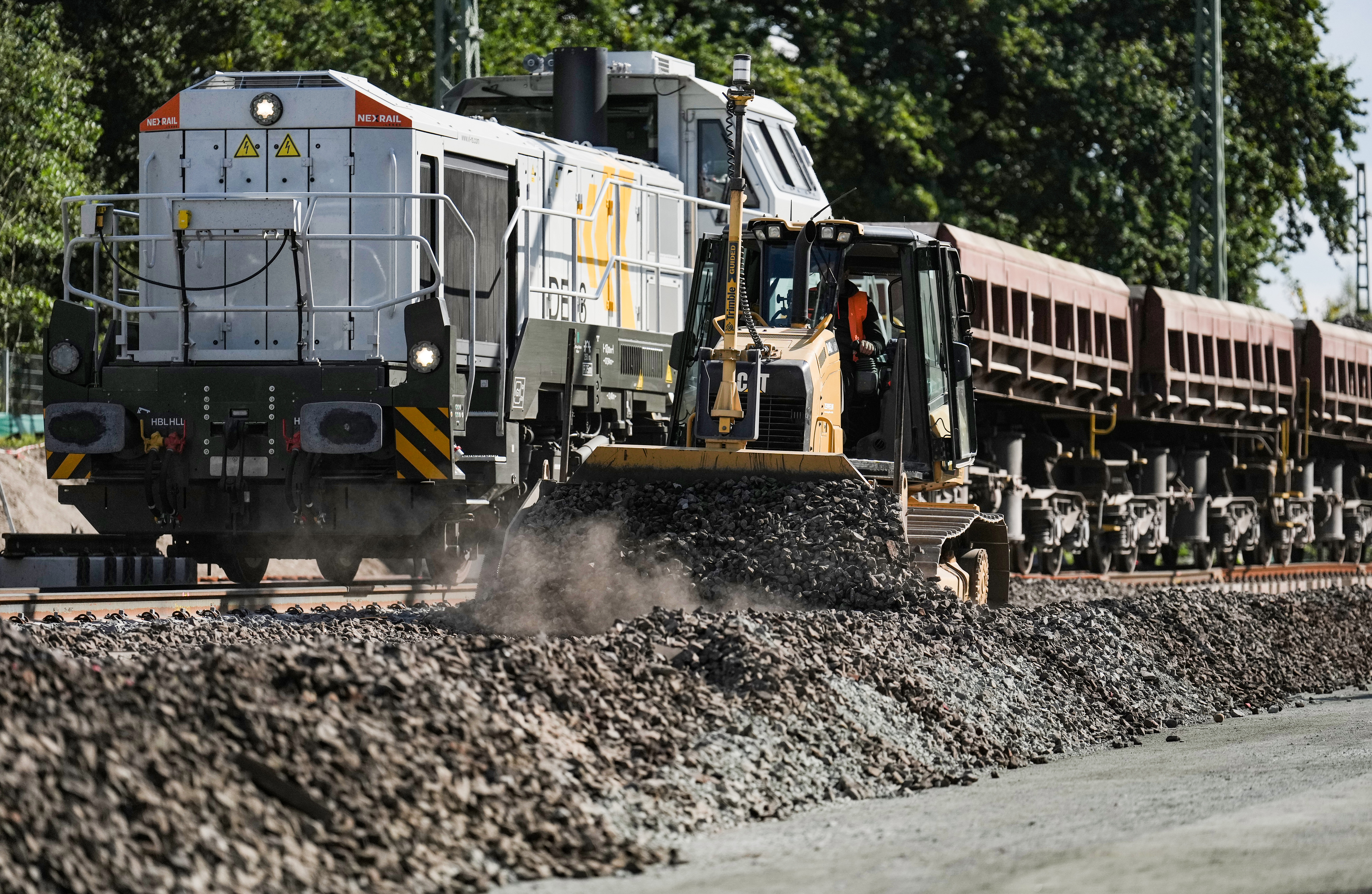
A large share of Deutsche Bahn’s Scope 3 emissions is attributable to the construction of rail transport and station infrastructure. In the 2019 base year, this accounted for around 70 percent of DB’s Scope 3.1 and 3.2 emissions. For this reason, DB is pursuing pilot projects involving low-emission steel and concrete.
2025 | 2024 | 2023 | |
|---|---|---|---|
| Scope 3: greenhouse gas emissions | 7.8 | 6.3 | 8.2 |
| Scope 3.1/3.2: purchased goods and services/capital goods | 6.1 | 4.7 | 5.8 |
| Scope 3.3: fuel- and energy-related activities | 1 | 1 | 1.4 |
| Scope 3.4: transportation and distribution (upstream) | 0.5 | 0.4 | 0.4 |
| Scope 3.11: use of sold products | 0.3 | 0.3 | 0.7 |
This includes the Scope 3 categories material to the DB Group: 3.1, 3.2, 3.3, 3.4 and 3.11. In 2025, the Scope 3.4 category was expanded for the first time to include transport-related emissions associated with purchased goods and capital goods.
Due to the currently limited data availability for many Scope 3 emissions, Deutsche Bahn is not yet able to present an absolute GHG reduction pathway as it does for Scope 1 and 2. As an alternative target system under SBTi, it uses the so-called Supplier Engagement Target (SET) for the relevant categories (Scope 3.1/3.2), namely purchased goods, services and capital goods.
Supplier Engagement Target
With the Supplier Engagement Target, DB’s suppliers are called upon to set science-based climate protection targets themselves. Deutsche Bahn’s goal is for 66 percent of its suppliers, based on GHG emissions volume, for purchased goods, services and capital goods (Scope 3.1/3.2) to set science-based climate protection targets by 2029.
Through active engagement and regular surveys, suppliers are to be encouraged and supported in reducing their emissions. Working together with suppliers helps make the entire value chain more climate-friendly.
For fuel- and energy-related activities (Scope 3.3), Deutsche Bahn has set an interim target to reduce GHG emissions by 40 percent by 2034 compared with 2019. For the use of products sold to customers outside DB (Scope 3.11), such as fossil fuels, emissions are also to be reduced by 63 percent by 2034.
 Go
Go